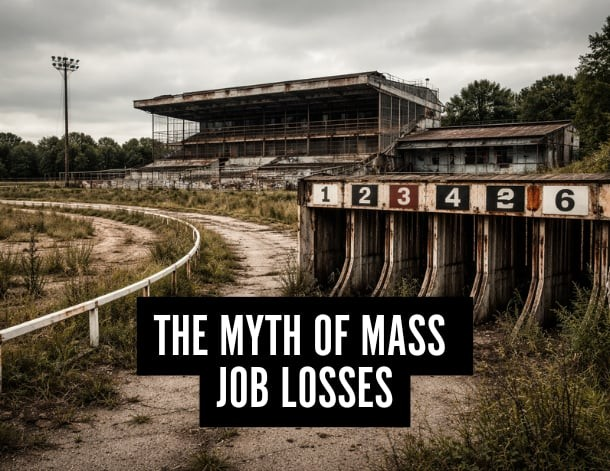
Supporters of greyhound racing in Western Australia frequently argue that banning the sport would devastate the economy and cost “thousands of people” their jobs and livelihoods. This claim is repeated often, but rarely scrutinised. When the available evidence is examined, it becomes clear that the scale of employment attributed to greyhound racing has been dramatically overstated and bears little resemblance to reality.
Greyhound Racing in WA: Largely a Hobby, Not a Livelihood
The vast majority of people involved in greyhound racing in Western Australia are not employed in the sport in any conventional sense. According to Racing and Wagering Western Australia (RWWA), most participants are hobbyists. Hobby participants are not regarded as running a business, do not pay tax on prize money or earnings, and are not dependent on racing for their primary income.
RWWA’s own figures from 2024 show:
This alone demonstrates that greyhound racing is not a major employment sector. For most participants, involvement is discretionary and recreational, comparable to other leisure pursuits – not a job on which a household depends.
Prize Money Promotion, Not Welfare
Greyhounds WA actively promotes participation by emphasising prize money rather than animal welfare. Its website encourages prospective owners to “take a look at the prize money on offer,” highlighting over $15 million in prize money and bonuses, while making no reference to the responsibilities, costs, or welfare outcomes associated with ownership.
This framing reinforces the reality that greyhound racing functions primarily as a gambling-linked hobby, not a labour-intensive industry providing stable employment.
Inflated Employment Claims and Flawed Economic Reports
Claims about widespread job losses rely heavily on industry-commissioned reports prepared by Industry and Employment Research (IER). These reports consistently exaggerate the size and importance of the racing sector through questionable methodology.
The most recent IER “Size and Scope of the Western Australian Racing Industry” report (published in 2023 using 2021–22 data) claims the racing industry supports 10,249 full-time jobs in Western Australia.
However, Australian Bureau of Statistics data records only 1,235 full-time employees across the entire WA racing sector, which includes thoroughbred and harness racing. This means the IER figure overstates employment by more than eight times.
The reason for this discrepancy is clear:
Presenting these inflated numbers as evidence of mass employment is misleading and creates a false impression of economic dependence.
Questionable Attendance and Ownership Data
Other key figures used to justify the industry are equally unreliable.
Again, the most likely explanation is multiple counting across syndicates and roles, further inflating the perceived scale of participation.
Gambling Losses Are Not an Economic Benefit
IER attributes $182.1 million in “direct expenditure” to the racing industry, but 92% of this figure consists of gambling losses.
Classifying gambling losses as a public economic benefit is deeply misleading. Western Australians lose approximately $1.3 billion every year to gambling, and greyhound racing punters lose nearly twice the national average per person. These losses contribute to financial stress, family breakdown, theft, and increased demand for social services – costs borne by the community, not the industry.
Money lost to gambling is also money not spent in local shops, hospitality, recreation, or other socially beneficial sectors.
Exaggerated Multipliers and Low Productivity
IER further inflates its estimates by applying economic multipliers that overstate real output. Government bodies including the WA Treasury’s Economic Regulation Authority, the Productivity Commission, and the Tasmanian Treasury have all warned that such multipliers can exaggerate impact by up to threefold.
Even using IER’s own figures, greyhound racing remains a low-productivity activity. Value added per worker is approximately $130,000, compared with $2.45 million in mining, making racing roughly 19 times less efficient.
This is not the profile of a vital or strategic industry.
Public Subsidies for a Private Hobby
Unlike other hobbies such as equestrian sports or motorsport, greyhound racing receives substantial taxpayer support through:
This effectively channels public money into sustaining a leisure activity for a small group of participants, rather than supporting services or industries of broader public benefit.
As Minister Amber-Jade Sanderson MLA observed on ABC Perth on 4 June 2025: “Throwing a large amount of money at a small number of people is not a sensible use of taxpayers’ funds.”
That principle raises serious questions about the continued public investment in greyhound racing.
The Cannington Racecourse: A Case Study in Opportunity Cost
The Cannington Greyhound Racecourse illustrates the broader economic problem. The racecourse occupies nearly half of a centrally located metropolitan property lot shared with a Bunnings Warehouse.
In 2022:
This disparity suggests either exceptionally favourable lease terms or severe underperformance. Either way, valuable urban land is being locked into a low-return, publicly subsidised activity under a 30-year lease, preventing alternative commercial or community uses.
Greyhounds WA’s own Chief Executive has acknowledged the racecourse could not operate without public funding, including $13 million in taxpayer money for a new track.
Conclusion: Jobs Claims Don’t Justify the Status Quo
The claim that banning greyhound racing would cost “thousands of jobs” in Western Australia is not supported by evidence. Employment figures are inflated, participation is overwhelmingly hobby-based, and the industry’s financial viability depends heavily on gambling losses and public subsidies.
Referring to greyhound racing as an “industry” obscures its true nature and normalises the treatment of animals as disposable economic units. It also distracts from the real costs – ethical, social, and economic – borne by the broader community.
When the facts are examined, it becomes clear that greyhound racing is not a significant employer, not economically productive, and not an efficient or equitable use of public resources. Ending taxpayer support for this activity would not destroy livelihoods — but it would free up funding and land for uses that better reflect modern community values and priorities.
Join our list and stay up to date with everything Free the Hounds!
Copyright © 2025 freethehounds.com.au | All Rights Reserved